
Coins.ph denies serving offshore gaming operators: what is reported and what is confirmed

Short answer — On 14 October 2026 Coins.ph published an official statement saying it keeps "offshore gaming and gambling operators off its platform" and continues "to operate as a BSP licensed institution". It was answering a CoinDesk report, citing unnamed people, that the Bangko Sentral ng Pilipinas (BSP) was pursuing action over alleged offshore gambling transactions. What is on record so far is narrower: since 29 September 2026 inbound InstaPay and PESONet transfers to DCPay Philippines, the company behind the Coins.ph peso wallet, have been partially suspended, as BitPinas reported. The only BSP words in the coverage we read are a one-line reply to BitPinas. No BSP finding of wrongdoing has been published.
This matters to Filipino players because e-wallets and crypto apps are how many people move money in and out of gaming accounts. Below we separate three things: what the news reports say, what Coins.ph says, and what the BSP has and has not said. Then we set out the timeline in days and what a player should take from it. Jili777 has no connection with Coins.ph, and nothing here is a claim that any company did anything wrong.
What did the reports say?
The story that set off the statement was a CoinDesk article dated 13 October in its web address and timestamped 14 October 2026, 01:00 UTC. CoinDesk attributed its main claims to people familiar with the matter, not to the BSP or to documents. As reported by CoinDesk:
- The alleged infractions were "said to involve serving offshore gambling firms", and one person said they were serious enough for the company to lose its licence.
- After the BSP's 2025 clampdown on gambling access in e-wallet apps, "several gambling entities migrated to Coins.ph, according to the people".
- The deposit restriction was not time-bound and, according to one person, no reason was given.
- Coins.ph has over 18 million customers and controls "some 75%-80%" of peso-to-stablecoin liquidity in the Philippines.
- The central bank "had not responded to requests for comment by publication time".
Those are claims by unnamed sources, carried by one outlet. They are newsworthy because of the size of the platform, but they are not findings. We repeat them only to show what Coins.ph was responding to.
What does Coins.ph say?
The official statement on the Coins.ph blog, timestamped 14 October 2026, says the company is aware of "claims about offshore gaming transactions and our engagement with the Bangko Sentral ng Pilipinas". Its main points, in its own order:
- It is "committed to serving only legitimate, compliant businesses and maintains strict controls to keep offshore gaming and gambling operators off its platform".
- It holds itself to the requirements of the BSP, the Anti-Money Laundering Council (AMLC) and other regulators.
- "Our users' funds are safe; we continue to operate as a BSP licensed institution."
- It expects "to fully restore affected services soon" and will post updates through official channels.
A version sent to the press was more direct. Fintech News Philippines reported on 14 October that the company said it "firmly denies any claim that it knowingly serves offshore gaming or gambling operators". The same report noted that the statement did not say when services would return and did not respond directly to the reported licence risk.
Two days later, in answers published by BitPinas on 16 October 2026, Coins.ph went further on licences and scope. It said that "all of our BSP licenses remain active", naming the virtual asset service provider (VASP) licence of Betur Inc. for crypto and the electronic money issuer (EMI) licence of DCPay Philippines Inc. for the peso wallet. It said the directive "only affects cash-ins to DCPay through InstaPay and PESONet", while crypto trading, cash-outs, bills and QR Ph payments continue. It described the BSP's request as part of "regular examination and regulatory oversight" asking for enhancements to controls, and said supervisory matters are confidential.
What has the BSP said, and what is on record?
This is the part most easily blurred in social media posts, so we keep it to sources.
The 2025 memo is a BSP document. BSP Memorandum M-2025-029, dated 14 August 2025, says the Monetary Board in Resolution No. 805 approved suspending in-app gambling access in BSP-supervised institutions' payment apps and websites, and instructs them to remove such links "within 48 hours". It names no company.
The September 2026 suspension is reported, with document numbers. BitPinas reported on 30 September 2026 that Philippine Payments Management, Inc. (PPMI) Advisory No. 2026-0929-029, citing Monetary Board Resolution No. 839, partially suspended DCPay Philippines from receiving InstaPay and PESONet credit transfers. Under that report, transfers into Coins.ph wallets from banks and other e-wallets are rejected, while outbound transfers and person-to-merchant QR Ph payments remain allowed. BitPinas also noted that Coins.ph briefly paused peso cash-outs internally for adjustments. We did not find the PPMI advisory itself on a public page, so we cite the report.
The BSP has not explained the suspension in public. BitPinas sent the central bank questions on the grounds of the order, any enforcement action and whether it reaches the crypto licence. The reply it published was: "We will provide information as and when appropriate." We found no BSP statement naming Coins.ph, describing a violation or announcing licence action. If one is published, it would replace everything in this section.
| Date | Event | Who says so | Days from previous event (our calculation) |
|---|---|---|---|
| 14 Aug 2025 | BSP orders removal of in-app gambling links within 48 hours | BSP memo M-2025-029 | — |
| 29 Sep 2026 | PPMI advisory under MB Resolution No. 839 partially suspends inbound transfers to DCPay | Reported by BitPinas (30 Sep) | 411 |
| 14 Oct 2026 | CoinDesk report citing unnamed sources on possible BSP action | CoinDesk | 15 |
| 14 Oct 2026 | Coins.ph statement: funds safe, still BSP-licensed, controls keep offshore operators out | Coins.ph | 0 |
| 16 Oct 2026 | Coins.ph says all BSP licences active; BSP replies it will share information "as and when appropriate" | Reported by BitPinas | 2 |
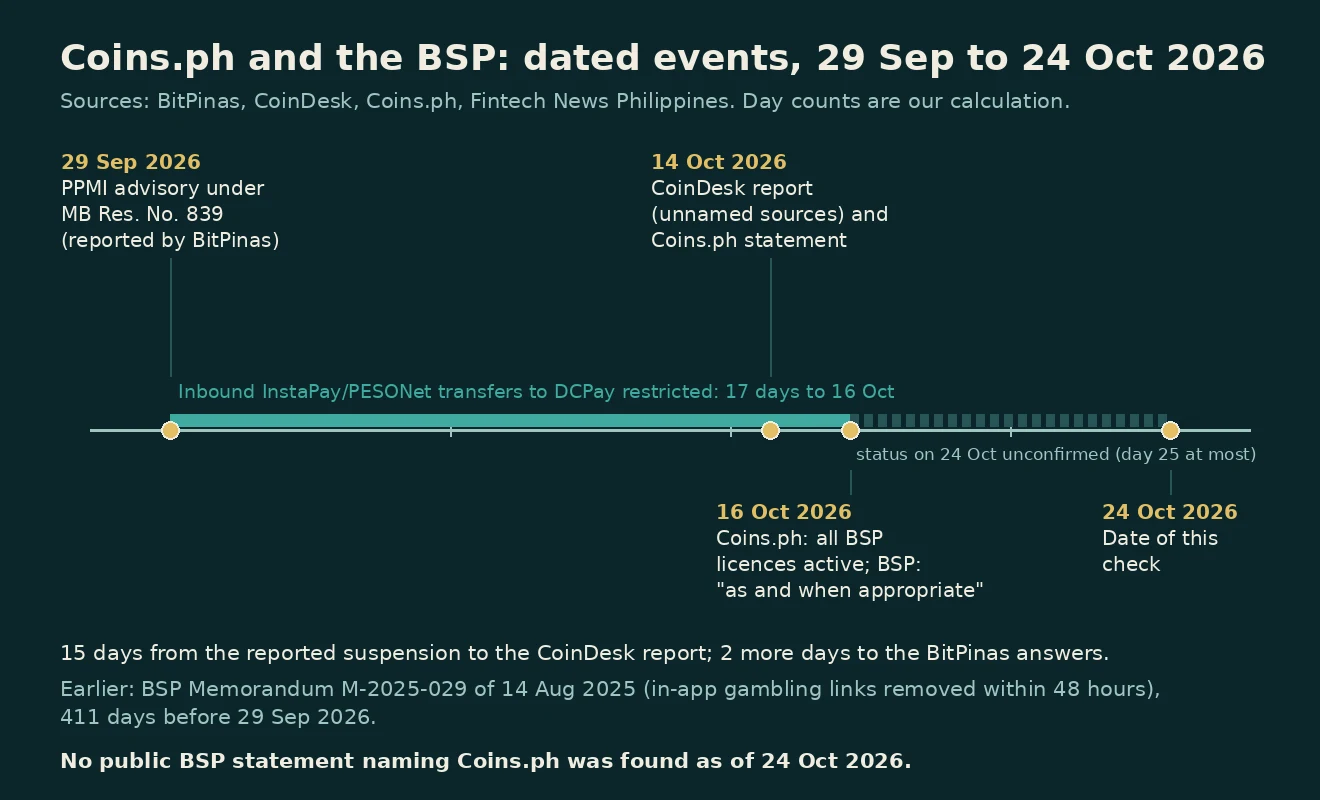
How long has the cash-in restriction lasted? Our count
Counting calendar days, our calculation gives 411 days between the August 2025 BSP memo and the 29 September 2026 suspension, and 15 days from the suspension to the CoinDesk report. By the BitPinas interview on 16 October the restriction had lasted 17 days, and the company was still describing cash-ins as affected. Today, 24 October 2026, is day 25 if it is still in place. We could not confirm its status today from a public BSP or Coins.ph page, so treat day 25 as a ceiling, not a verified fact.
A practical example shows what the restriction means in pesos. Suppose a user tries to send ₱3,000 from a bank or another e-wallet to their Coins.ph peso wallet by InstaPay. Under the order as reported, that transfer is rejected. A ₱3,000 balance already inside the wallet could still be sent out to a bank, or spent through QR Ph at a merchant, because outbound and merchant payments were left open. Neither case involves gambling; it is simply how the suspension works as described.
What does this mean for players who fund gaming accounts by e-wallet or crypto app?
None of the sources say that ordinary users did anything wrong, and Coins.ph says user funds are safe. The episode still carries lessons for anyone who plays online in the Philippines.
- Play only on licensed platforms. The PAGCOR responsible gaming page asks players to check that a website or online gaming platform is PAGCOR-licensed "before you play or pay" at pagcorguarantee.ph, and lists persons under 21 among those prohibited from gambling. Offshore operators are exactly the businesses the 2025 memo and the current reports are about.
- Use the channel the platform names. Pay through the cashier inside a licensed platform, not by sending pesos or crypto to an agent, a personal QR code or a wallet address passed around in a chat group. A payment you cannot tie to the platform is hard to trace if something goes wrong.
- Keep your own records. Save the reference number, amount, date and receiving account of every top-up and withdrawal. If a payment provider pauses a service, as happened here, records are what let you show where your money went.
- Do not rely on one wallet. A licensed operator usually lists more than one payment option. If a channel is restricted, wait for the operator's own notice instead of looking for workarounds.
- Know where to report. PAGCOR's page lists the CICC hotline for illegal gaming sites, a helpdesk for problems with online gaming platforms and the National Problem Gambling Helpline.
What is still unconfirmed?
- Whether the BSP has found any violation by Coins.ph or DCPay. No public BSP statement says so.
- The reason for Monetary Board Resolution No. 839 and whether the suspension has an end date. Neither has been published.
- Whether any licence action is under consideration. That claim rests on unnamed sources quoted by CoinDesk; Coins.ph says its licences are active.
- When InstaPay and PESONet cash-ins will return. Coins.ph said "soon" on 14 October without a date.
- The assigned AGBrief recap of 15 October 2026 returned a "page not found" error when we checked it, so we did not use it.
Sources (checked 24 October 2026): Coins.ph, Official Statement (14 Oct 2026); CoinDesk (14 Oct 2026, 01:00 UTC); Fintech News Philippines (14 Oct 2026); BitPinas exclusive (16 Oct 2026); BitPinas on the DCPay suspension (30 Sep 2026); BSP Memorandum M-2025-029; PAGCOR responsible gaming. Day counts and the peso example are our calculation. Claims by unnamed sources are reported as claims, not facts.