
Slot ways counts: match each consecutive reel before multiplying
Eight matching symbols spread across a slot board do not necessarily form eight winning ways. For a ways rule that starts on the first reel and continues through adjacent reels, the relevant count is the number of qualifying symbols on each consecutive reel.
This guide expands the format questions in the Jili777 slot library with one fictional board. The example is deliberately separate from any JILI game edition, operator configuration or real spin.

Define the rule before looking at the board
Our invented model has five reels, each showing four positions. Symbol A is the target. A qualifying way chooses one A position on each consecutive reel starting with reel 1. At least three consecutive reels are required. There are no Wilds, Scatters, symbol expansions or additional screens in this model.
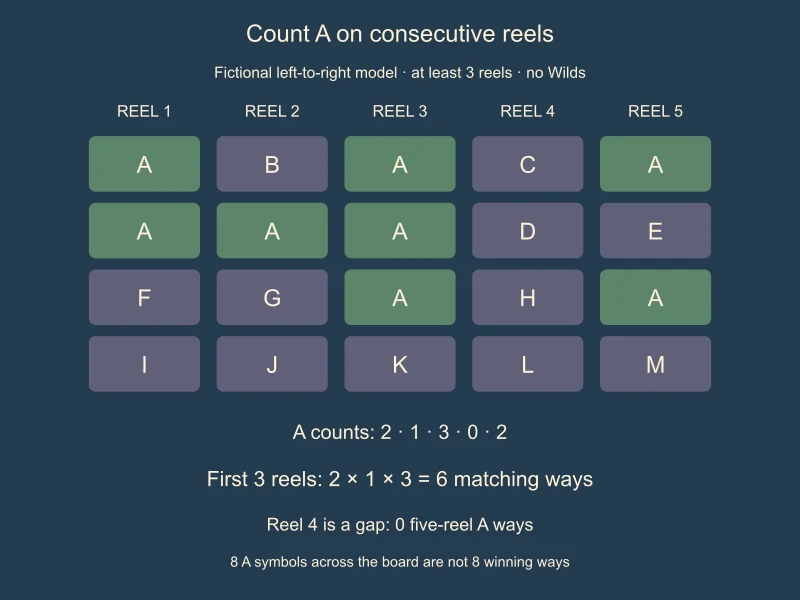
The eight A symbols are distributed as follows. Each column below is a reel; each row is a visible position:
| Position | Reel 1 | Reel 2 | Reel 3 | Reel 4 | Reel 5 |
|---|---|---|---|---|---|
| Top | A | B | A | C | A |
| Second | A | A | A | D | E |
| Third | F | G | A | H | A |
| Bottom | I | J | K | L | M |
| A count | 2 | 1 | 3 | 0 | 2 |
The full-board A count is 2 + 1 + 3 + 0 + 2 = 8. That is a symbol count. It is not yet the count of qualifying paths under the stated rule.
Multiply choices on the consecutive matching reels
For the first three reels, choose one of the two A positions on reel 1, the one A position on reel 2, and one of the three A positions on reel 3. The number of choices is 2 × 1 × 3 = 6. Each choice identifies a different three-reel way.
Using row numbers 1 through 4, the six position triples are (1,2,1), (1,2,2), (1,2,3), (2,2,1), (2,2,2) and (2,2,3). These triples make the calculation reproducible. They can share positions while remaining different combinations of positions.
No A appears on reel 4, so the sequence stops after reel 3. The two A symbols on reel 5 do not bridge that gap. There are zero four-reel or five-reel A ways under the declared left-to-right rule. Multiplying only the nonzero counts, 2 × 1 × 3 × 2, would incorrectly skip reel 4 and invent twelve qualifying ways.
A displayed maximum counts something else
A fixed five-reel, four-position layout has 4 × 4 × 4 × 4 × 4 = 1,024 potential five-position paths if every visible position can be selected. That layout count does not say that 1,024 paths contain the required symbol on a particular board.
In our board, 20 visible positions, eight A symbols, six qualifying three-reel A ways and zero five-reel A ways are all correct counts of different things. None is a probability. The model does not define symbol-generation probabilities, so it cannot establish how often this board or a prize occurs.
A real game can also change its reel shape or effective positions during a feature. Its actual rules determine what a displayed ways label includes. The existing guide to paylines, ways and clusters explains why those structures cannot be compared simply by choosing the largest advertised number.
The paytable supplies the amount and unit
To illustrate the final arithmetic only, suppose our invented rule pays 5 units for each qualifying three-reel A way and pays only the longest qualifying length for that symbol. Six such ways would produce 6 × 5 = 30 units of gross award for A. This hypothetical amount is not a JILI paytable value, selectable stake or actual return.
Before applying a similar calculation to a real screen, determine whether its paytable amount refers to a coin unit, line bet, total stake or another defined basis. A displayed multiplier cannot be converted into currency without that basis. Other symbols or features may have separate rules; our A calculation does not claim to total an entire real round.
The UK Gambling Commission's RTS 3 emphasizes understandable winning conditions and payout calculations within its Great Britain regulatory scope. We use that as a reason to state the example rule and unit clearly. It does not certify this website or provide a JILI game's ways formula.
Use a short sequence check
Start with the target symbol and matching direction. Count the eligible positions on each required reel, retain any zero in the sequence, and stop at a gap when the applicable rule requires consecutive reels. Check the minimum length before multiplying the qualifying position counts.
A useful note for this board is “A counts 2–1–3–0–2; longest consecutive run from reel 1 is three reels; six qualifying ways; hypothetical A award 30 units.” It records what was counted without describing the eight visible symbols as eight wins.
Source and complete position enumeration checked on 10 October 2026. The board and rule are original teaching examples. No real spin, game configuration, RTP or operator availability was tested for this guide.