
PAGCOR keeps the freeze on new online gaming licences: what the numbers show
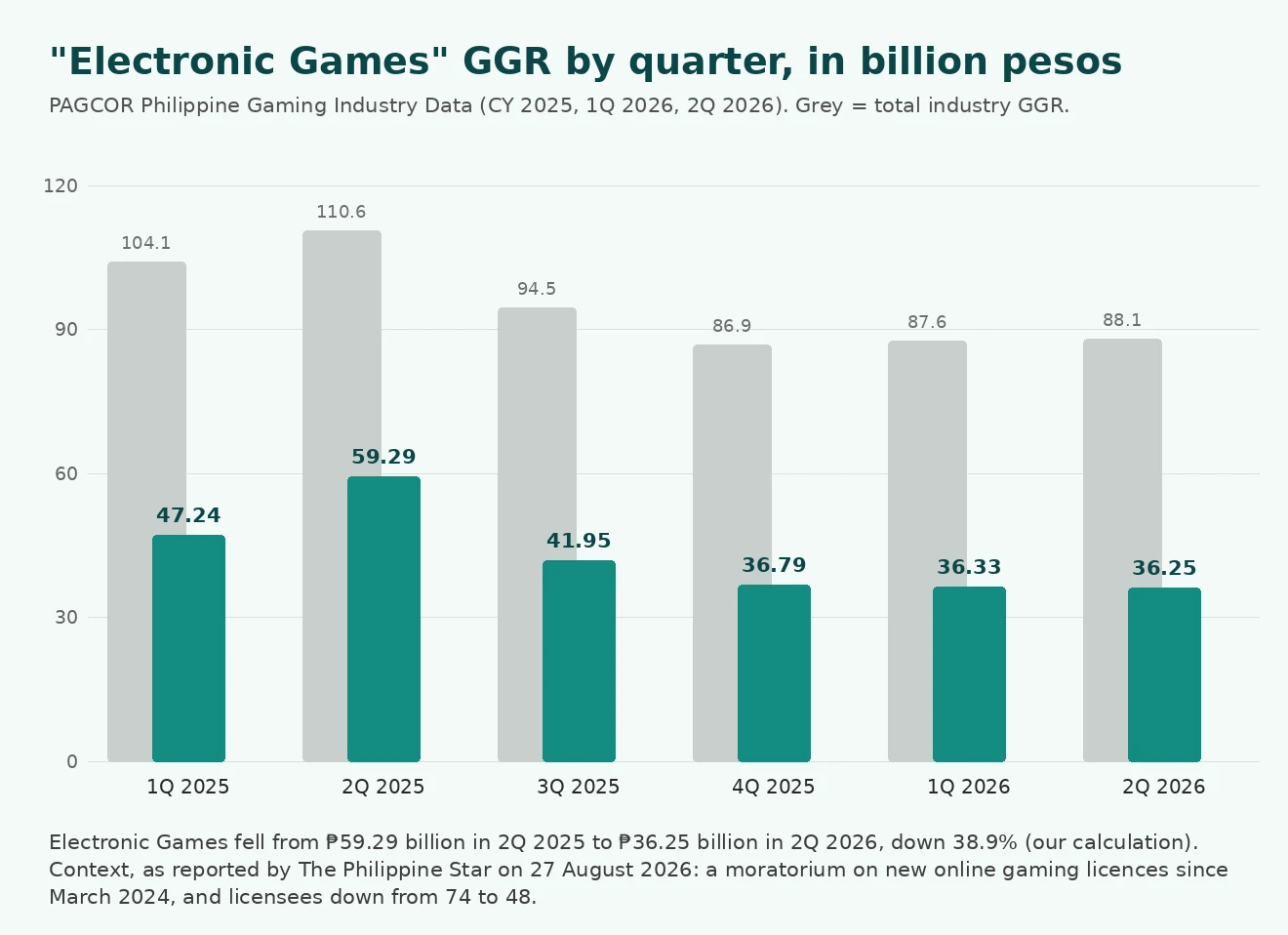
Short answer — PAGCOR chairman and CEO Alejandro Tengco said in late August 2026 that the regulator has no plans to issue new online gaming licences for now, keeping a moratorium that began with a March 2024 board resolution, The Philippine Star reported on 27 August 2026. He put the number of online gaming licensees at 48, down from 74, and said fee rates of 30% of gross gaming revenue (GGR) for e-game operators would not change. PAGCOR's own data show the "Electronic Games" line falling from ₱59.29 billion in the second quarter of 2025 to ₱36.25 billion a year later, a 38.9% drop by our calculation.
For a player in the Philippines, the freeze is not an abstract policy story. It decides how many legal online platforms exist, and therefore how much harder it should be for an unlicensed site to look like a licensed one. This article sets out what was said, checks it against PAGCOR's published figures, and explains what the numbers can and cannot tell you.
What exactly did PAGCOR's chief say?
According to The Philippine Star's report of 27 August 2026 by Aubrey Rose Inosante, Tengco spoke on the sidelines of a House committee on appropriations hearing. The newspaper reported four points:
- No new online licences for now. He saw no need to lift the moratorium imposed through a board resolution in March 2024. "For now, I want the whole industry to consolidate," he said, so "the weak can leave".
- Fewer licensees. The number of online gaming licensees had fallen to 48 from 74. He said some licence holders had been "keeping the licenses idle, trying to sell them".
- No fee change. Fees stay at 30% of GGR for e-game operators and 25% for integrated resorts, effective 1 January, with Tengco saying "Nothing will change".
- Enforcement on promotions. PAGCOR fined an online gaming company ₱1 million over a social-media giveaway and warned that a repeat could lead to suspension or cancellation of its licence.
These statements come from a newspaper report of remarks made in Filipino and English. We did not find a PAGCOR press release repeating the 48 and 74 figures, so treat them as reported, not as published by the regulator. The GGR figures below, by contrast, come straight from PAGCOR's own data files.
What do PAGCOR's own figures show?
PAGCOR publishes quarterly "Philippine Gaming Industry Data" files on its regulatory pages, based on records submitted to the Governance Commission for GOCCs. We read the CY 2025 file, the 1Q 2026 file and the 2Q 2026 file on 22 October 2026. Figures are rounded to two decimals; the share column is our calculation.
| Quarter | Electronic Games GGR | Total industry GGR | Electronic Games share |
|---|---|---|---|
| 1Q 2025 | ₱47.24 billion | ₱104.12 billion | 45.4% |
| 2Q 2025 | ₱59.29 billion | ₱110.63 billion | 53.6% |
| 3Q 2025 | ₱41.95 billion | ₱94.52 billion | 44.4% |
| 4Q 2025 | ₱36.79 billion | ₱86.87 billion | 42.3% |
| 1Q 2026 | ₱36.33 billion | ₱87.60 billion | 41.5% |
| 2Q 2026 | ₱36.25 billion | ₱88.14 billion | 41.1% |
Three things stand out, all by our calculation from these files:
- The drop is concentrated in one line. Electronic Games fell 31.9% in the first half of 2026 against the first half of 2025 (₱72.58 billion against ₱106.53 billion). Total industry GGR fell 18.2% over the same period.
- The slide has flattened. After the 2Q 2025 peak, the line fell for two quarters, then held between ₱36.25 billion and ₱36.79 billion for three quarters in a row.
- The full-year 2025 total matches the newspaper. PAGCOR's file shows ₱396.14 billion for 2025, the same figure The Philippine Star used. The newspaper also reported a 2026 estimate of about ₱370 billion, which would be 6.6% lower.
PAGCOR's own 2Q 2026 headline says industry GGR fell 20.33% year on year to ₱88.13 billion, "largely driven by weaker revenues from the electronic gaming segment", and Tengco also cited inflation and tensions in the Middle East. That release describes the electronic gaming sector as including "E-Games, E-Bingo, bingo and poker", so the regulator's broader sector figure (₱39.85 billion) is not the same as the narrower Electronic Games line in our table.
Is the licence freeze the reason revenue fell?
The data cannot prove that. The moratorium dates from March 2024, and Electronic Games revenue was still rising into mid-2025, so the freeze alone does not explain the fall that followed. Other events in the same window include the BSP's August 2025 order for payment apps to remove in-app gambling links, which we cover only as context here, and the factors PAGCOR itself names. What the numbers do support is a narrower statement: the number of licensees shrank by 26, or 35.1%, by our calculation, while the segment's quarterly revenue has stopped falling. That pattern is consistent with Tengco's description of a market consolidating around fewer operators, but it is not evidence that each remaining licensee now earns more, because revenue per licensee is not published.
What does the 30% fee mean in pesos?
As an illustration only, applying the reported 30% rate to the first-half 2026 Electronic Games line gives about ₱21.8 billion, by our calculation. That is not PAGCOR's reported fee income: the line may include products with different rates, and PAGCOR's actual revenue figures are reported separately. It shows the scale involved, and why Tengco said rates must stay constant "to have a constancy in our revenue".
How are online games licensed in the Philippines?
The freeze makes more sense once you see how PAGCOR's licensing is organised. Its Electronic Gaming Licensing Department (EGLD) page says the department regulates local gaming operations other than land-based casinos, including traditional bingo, electronic bingo, electronic casino games ("eCasino"), sports betting, specialty games, online poker and numeric games. It issues a separate Gaming License for each of those game offerings.
The same page describes a structure that many players do not know about: a service provider's electronic gaming platform and its games "must be offered at the gaming venue", with the remote or online operation described as "an adjunct service for its registered players". In other words, an online licence in this system is tied to a licensed venue and its operator, not issued to a stand-alone website. The EGLD also accredits the service providers behind platforms and approves the games deployed on them, which is why the page lists application kits for dozens of game studios.
Three layers therefore have to line up for a legal online session: a licensed operator, an accredited platform with registered brands and domains, and approved game content. A freeze on new online licences stops the first layer from growing. It does not, by itself, stop studios from releasing new games to the operators that already hold licences, which is why new titles keep appearing even while the number of licensees falls.
What does a licence freeze mean for players?
A smaller, closed list of licensed platforms is easier to check. PAGCOR's responsible gaming page tells players to verify that a website or platform is licensed at pagcorguarantee.ph before they play or pay, and it lists persons under 21 among those barred from all online gaming platforms. The EGLD page also links to a published list of accredited gaming system administrators with their registered brands and domain names.
Two practical points follow from the freeze:
- A "newly licensed" claim is a warning sign. If PAGCOR is not issuing new online licences, a platform that advertises itself as newly licensed by PAGCOR should be checked before you deposit anything.
- Game approval is not operator approval. The same PAGCOR page lists application kits for game content, including JILI, Pragmatic Play and many others. A game appearing in those lists does not make every site offering it a licensed platform.
What is still unconfirmed?
- The 48 and 74 licensee counts come from the newspaper report; we found no PAGCOR document stating them.
- The March 2024 board resolution is described in the report but we did not find its text on PAGCOR's website.
- How long the freeze lasts. Tengco said PAGCOR will "decide if we will issue licenses next time" after consolidation; no date was given.
- The ₱370 billion 2026 estimate is reported, not published by PAGCOR.
If you or someone close to you is spending more than planned, PAGCOR's responsible gaming page lists its online self-exclusion portal and the National Problem Gambling Helpline. Both are free, and neither depends on which platform you used.
Sources (checked 22 October 2026): The Philippine Star, 27 August 2026 (reported statements); PAGCOR industry data files for CY 2025, 1Q 2026 and 2Q 2026; PAGCOR 2Q 2026 headline; PAGCOR responsible gaming. Shares, percentage changes and the fee illustration are our calculation.